V2X technologies enable vehicles such as transit, freight, and emergency vehicles to communicate with traffic signals and infrastructure in real-time. TSP enables designated vehicles to request extended green or early green from a traffic signal controller. This can reduce delays and improve reliability for prioritized vehicles and enhances safety by reducing conflicts at intersections.
Vehicle-to-Everything (V2X) Technology
2024 Executive Briefing
 BRIEFING HIGHLIGHTS
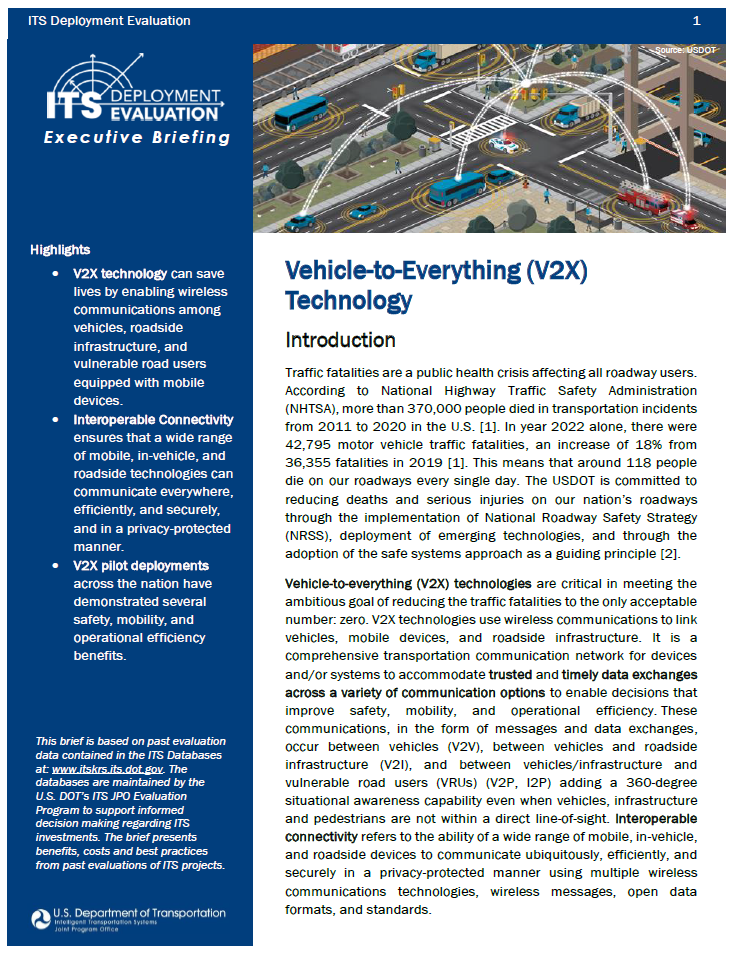
- V2X technology can save lives by enabling wireless communications among vehicles, roadside infrastructure, and vulnerable road users equipped with mobile devices.
- Interoperable Connectivity ensures that a wide range of mobile, in-vehicle, and roadside technologies can communicate everywhere, efficiently, and securely, and in a privacy-protected manner.
- V2X pilot deployments across the nation have demonstrated several safety, mobility, and operational efficiency benefits.
Introduction
Traffic fatalities are a public health crisis affecting all roadway users. According to National Highway Traffic Safety Administration (NHTSA), more than 370,000 people died in transportation incidents from 2011 to 2020 in the U.S. [1]. In year 2022 alone, there were 42,795 motor vehicle traffic fatalities, an increase of 18% from 36,355 fatalities in 2019 [1]. This means that around 118 people die on our roadways every single day. The USDOT is committed to reducing deaths and serious injuries on our nation’s roadways through the implementation of National Roadway Safety Strategy (NRSS), deployment of emerging technologies, and through the adoption of the safe systems approach as a guiding principle [2].
Vehicle-to-everything (V2X) technologies are critical in meeting the ambitious goal of reducing the traffic fatalities to the only acceptable number: zero. V2X technologies use wireless communications to link vehicles, mobile devices, and roadside infrastructure. It is a comprehensive transportation communication network for devices and/or systems to accommodate trusted and timely data exchanges across a variety of communication options to enable decisions that improve safety, mobility, and operational efficiency. These communications, in the form of messages and data exchanges, occur between vehicles (V2V), between vehicles and roadside infrastructure (V2I), and between vehicles/infrastructure and vulnerable road users (VRUs) (V2P, I2P) adding a 360-degree situational awareness capability even when vehicles, infrastructure and pedestrians are not within a direct line-of-sight. Interoperable connectivity refers to the ability of a wide range of mobile, in-vehicle, and roadside devices to communicate ubiquitously, efficiently, and securely in a privacy-protected manner using multiple wireless communications technologies, wireless messages, open data formats, and standards.
V2X communications need to be interoperable to be successful, meaning that a vehicle from one original equipment manufacturer (OEM) needs to be able to communicate with vehicles from another OEM or a vehicle needs to be able to communicate with infrastructure regardless of jurisdictional boundaries (e.g., a vehicle traveling from California to Texas to Maine needs to be able to communicate with systems in each state, and a vehicle registered in Virginia can communicate with roadside units [RSUs] in California). The USDOT has published a National V2X Deployment Plan that lists short-term to long-term goals to help accelerate V2X deployments using both the 5.9 GHz Safety Band and communications outside the 5.9 GHz Safety Band (including network-based communications technologies) [3].
Figure 1 represents the high-level block diagram of the individual elements within various systems of the architecture than form a V2X ecosystem. These systems include V2X and ITS Roadside Infrastructure (e.g., ITS sensors, detectors, signal controllers, RSUs, etc.), In-Vehicle Systems (e.g., vehicle controller area network or CAN BUS, on-board units [OBUs], human machine interface or HMIs, VRU mobile devices, etc.), TMC/Back-Office Systems (e.g., traffic control systems, data storage, back-office networks, etc.), V2X External Support Systems (e.g., positioning and timing, device certification, security credential management system or SCMS, etc.), and V2X Communications layer that enables communication between and among vehicles, VRUs, and roadside infrastructure.

This executive briefing focuses on the concepts of interoperable connectivity and V2X. Read on to learn how interoperable V2X deployments can contribute to enable a safe and efficient transportation ecosystem.
| Interoperable V2X Connectivity is a crucial, tested, and proven lifesaving tool in the safety toolbox ready to deploy now. |
Benefits
Not only does V2X technology save lives, but it also enhances mobility and bolsters efficiency. Nationwide pilot deployments and testing of various V2X use cases have demonstrated several benefits and promising results. Some of these use cases and associated deployment benefits are compiled below in Table 1.
Table 1: V2X Use Cases and Associated Benefits (Results from Deployments and/or Simulation Studies)
| Agency/Location | V2X Use Case / Deployment | Benefits / Results |
|---|---|---|
| Greater Cleveland Regional Transit Authority (GCRTA) - Results from Deployment | A pedestrian crossing warning system (V2I, I2P) that included 24 buses equipped with OBUs and three intersections equipped with an RSU, issued alerts to the bus drivers when pedestrians, within the crosswalk of an RSU equipped intersection, were in the intended path of the bus. | Reduced bus driver reaction time to pedestrian conflicts by 19% (from 1.6 seconds to 1.3 seconds) (2022-B01675). Another simulation study in California estimated that communications between vehicles and VRUs can reduce 97% of the crashes where vehicles are turning into the path of a pedestrian or bicyclist (2022-B01689). |
| Indiana DOT - Results from Deployment | Deployed queue warning trucks (V2I) ahead of the interstate work zones to alert motorists of queued traffic. The alerts were both visual (queue truck warning) and digital (in-vehicle navigation). | Resulted in an approximate 80% decrease in hard braking events thus lowering the likelihood of crashes. The traffic speeds gradually decreased from 1,500 to 2,000 feet in advance of the location where queue trucks were deployed indicating the effectiveness of alerts (2023-B01745). |
| Connecticut DOT - Results from Deployment | Deployed cloud-based digital alerting system (V2I) to reduce the risk of collision by giving motorists and vehicles advanced warnings of alerting hazards on the road. | Digital alerts lowered the risk of collision with roadside workers by up to 90% and reduced hard-braking events by 80% (2024-B01868). |
| Alpharetta, Georgia (Fulton County) – Results from Deployment | Pilot deployment revealed safety, mobility, and efficiency benefits for a school bus signal priority (V2I) application that detects the approaching vehicles and extends the green phase to allow for the connected vehicles to pass through an intersection without stopping. | The school bus priority application resulted in a 40% decrease in number of stops, a 13% reduction in travel time, and an 18% increase in speed (2023- B01804). Fuel consumption was also decreased by 7.4% for propane-powered and 12.4% for diesel-powered bus. |
| Utah DOT (Salt Lake City) - Results from Deployment | Field tested V2X technology to determine how signal preemption (V2I) could benefit snowplow operation in Salt Lake City. RSUs were deployed in five corridors to measure traffic signal, snowplow and vehicle efficiency impacts. | V2X equipped routes had a larger reduction in roadway crash rates (up to 3.87) compared to their non-equipped counterparts (1.82) between the snow season of 2018-2019 and 2019-2020 (2023-B01752). V2X-enabled snowplows also stopped fewer times from requesting and being granted preemption and had a decrease in roadway crash severity (e.g., no injury/property damage only events were reduced by 22%). |
| Tampa Hillsborough Expressway Authority (THEA) – Results from Deployment | Connected vehicle pilot in Tampa, Florida revealed several safety and mobility benefits of V2X applications such as Forward Collision Warning (FCW) (V2V) and End of Ramp Deceleration Warning (ERDW) (V2I). | Reduced the rate of forward collision conflicts by 9% and travel time by 30% (2021-B01583). |
| Columbus, Ohio - Results from Deployment | Deployed V2X infrastructure along four corridors to exchange critical situational data between infrastructure and vehicles, and between individual vehicles. The collected data was used to alert drivers of potential safety issues through a heads-up display via Reduced Speed School Zone Warning (V2I) application. | Increased driver compliance of posted speed limits in school zones from 18% to 56%. 13% of the vehicles decreased to below the school zone speed limit in under two seconds after a warning had been issued (2022-B01674). |
| Crash Avoidance Metrics Partners (CAMP) for USDOT – Results from Simulation | Simulation model evaluated the delay reductions on the Farm to Market Road 1960 (FM 1960) in Houston using Traffic Optimization for Signalized Corridor (TOSCo) (V2V, V2I) applications employing V2X Communications. | Reduction in vehicle stop delays by 50% in large metropolitan areas where V2V and V2I technology market penetration increases (2023-B01741). |
Costs
A Synthesis and Analysis Study1 in 2020 Gathered Information on V2X Infrastructure Deployment Cost Components including SCMS for Various Locations across the United States (2022-SC00514). These cost components vary based on a variety of factors including but not limited to location, manufacturer, system integration, existing fiber optics and other supporting infrastructure, types of applications and messages supported, IT infrastructure upgrades, and back-office provisioning of messages to application. The cost components are summarized in Table 2 below:
Table 2: V2X Infrastructure Deployment Cost Components
| V2X Equipment | Cost Range | Additional Notes |
|---|---|---|
| RSU (Hardware) | $900 - $5,250 | Unit cost |
| RSU (Design, Configuration, Deployment, Integration, Testing) | $1,000 - $8,000 | Unit cost |
| Signal Controller (Upgrade) | $2,200 - $13,000 | Per signal |
| OBU (Hardware) | $600 - $2,800 | Unit cost |
| OBU (Design, Deployment, Integration, Testing) | $850 - $10,000 | Unit cost |
Other cost components included backhaul networks (fiber optics cable design and installation, upgrades, SCMS), back office/transportation management center (TMC) data, V2X platform and application (systems engineering, development, analytics, back-office provisioning of messages to applications), and other costs (ITS architecture update, workforce addition/training, program management and systems operations and maintenance or O&M). The sample costs associated with the 10 deployment sites are listed below (2022- SC00514):
- Minnesota DOT spent approximately $100,000 on back-office communication and backhaul upgrades for its 22-signal Connected Corridor project along Hwy 55 in the Twin Cities region.
- Georgia DOT roughly estimated the cost of implementing an SCMS for the full deployment of planned V2X infrastructure at 1,700 intersections in metro Atlanta to be $240,000.
- Utah DOT estimated $16,000 for corridor data collection and development of corridor image tiles to support TSP for its joint project with Utah Transit Authority to implement the 11-mile bus rapid transit service.
- The City of Columbus reports a $210,980 contract for application systems engineering and development related to the 1,800 OBUs installed on private, emergency, transit, and freight vehicles used in the Smart Columbus project.
- Florida DOT estimated $59,500 for an RSU central management system for its 50-RSU Gainesville Signal Phase and Timing (SPaT) Trapezium project. It also estimates $156,300 for implementation plans, system integration, testing, validation, and verification for the complete project system (50 RSUs, 27 signal locations, and 71 OBUs).
- Washington State DOT listed the per RSU/signal cost of MAP file configuration as $220 for its SR 522 Corridor SPaT deployment.
- Wyoming DOT budgeted about $574,000 for system architecture and design for its I-80 pilot.
- The City of Columbus spent $65,000 on identifying, hiring, and training local staff to support OBU installation for 1,800 OBUs installed on private, emergency, transit, and freight vehicles used in the Smart Columbus project. In addition, their vendor estimated $110,200 in staff time for the installation.
- Washington State DOT lists the ongoing O&M for its 10 RSU/signal deployment along SR 522 as $2,000-$3,000 per year per intersection.
Best Practices
While V2X deployments have demonstrated a variety of safety, mobility, and operational efficiency benefits, there are many lessons that can be drawn from these projects to accelerate widescale industry adoption of interoperable V2X technologies. Below are some key lessons learned, and best practices identified from these projects:
 USDOT announces the national V2X deployment plan highlighting the need for coordinated efforts from various stakeholders to support nationwide interoperable V2X deployments. |
- Achieving interoperability requires close coordination and collaboration across and between the government, industry experts, vehicle manufacturers, infrastructure owners and operators (IOOs), original equipment manufacturers (OEMs), and the public, among other stakeholders. Collaborate with equipment vendors, service providers, standards committees, and developers to add compatibility to older standards and to maintain a stable telecommunication network to avoid disruptions to or from other devices (2023-L01176). USDOT’s leadership in collaborating closely with established national standardization initiatives, alongside industry, academia, and stakeholder representatives can help formulate standards for data exchange and integration (2024-L01224).
- USDOT should take the lead on V2X data standard initiatives and create standards for data privacy and security (2024-L01224). Standardization efforts guarantee seamless interoperability and enhanced efficiency throughout the V2X ecosystem. USDOT’s leadership in collaborating closely with established national standardization initiatives, alongside industry, academia, and stakeholder representatives can help formulate standards for data exchange and integration.
- Develop applications for both VRUs and vehicles to enable bidirectional communication and information exchange through V2X connectivity. The VRU application will provide collision warnings and situational awareness to pedestrians and cyclists using data from nearby connected vehicles and infrastructure. Conversely, a vehicle application will receive VRU location alerts to enhance driver awareness and safety (2024-L01229).
- Implement standards for data privacy and security. Implementing comprehensive privacy and security standards for connected vehicles and V2X communications is crucial to ensure public trust and awareness in data protection measures. An SCMS offers a secure and privacy-preserving method for V2X devices to share and receive information via digital certificates. Strong leadership is needed to manage data security effectively, navigate liability issues, and conduct regular security audits. Test the functions of the SCMS prior to deployment and anticipate additional deployment time required for registering OBUs with the SCMS for cybersecurity (2023-L01176, 2023-L01192). Additional delays may be expected stemming from equipment manufacturers’ unit scaling efforts. Such delays could hamper an IOO’s ability to improve safety through V2X applications. Develop proactive monitoring and reporting mechanisms for security certificates and optimize firmware for efficient data management (2024-L01214). Persistent issues with security certificate expiration and large log file sizes can hinder the normal processing of V2X messages. Regularly update and optimize RSU firmware to manage log file sizes effectively. Adopting strategies like pre-downloading three years' worth of security certificates or setting up weekly monitoring for certificate statuses can facilitate early problem identification and resolution.
- Conduct durability tests to ensure antenna mounting supports V2X communications for large vehicles under extreme weather conditions such as extreme cold and snow. Conduct interoperability tests to identify potential issues that would require resolution prior to the operational deployments (2024- L01214).
- Consider combination of techniques to improve positioning accuracy and to support safety critical V2X applications that require lane-level accuracy of less than 1.5 meters. The “urban canyon” effect in dense urban settings can impact the accuracy of Global Navigation Satellite Systems (GNSS) for V2X applications. To improve the positioning accuracy, techniques such as dead reckoning, CAN bus integration for speed data, and RSU time-of-flight features can be combined (2024-L01214).
Success Story
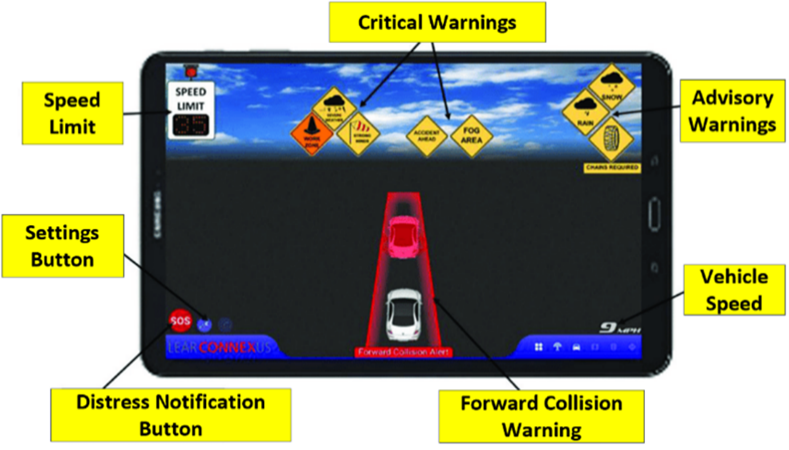
Interstate 80 (I-80) runs 402 miles along the southern edge of Wyoming and serves as a major freight corridor in the U.S., where truck volume accounts for about 70% of the traffic stream [4]. The corridor experiences severe weather events (e.g., icy road conditions, poor visibility, and high wind) which leads to adverse impacts in the form of higher-than-normal incident rates, multi-vehicle crashes, and traffic fatalities alongside societal costs. In 2016, the USDOT awarded Wyoming DOT $4.4 million under the Connected Vehicle (CV) Pilot Deployment Program to develop and deploy a suite of V2X applications to spur innovation among early adopters of V2X technologies [4]. The goal was to reduce crashes, crash severity, and road closures, improve emergency management, improve truck parking, and improve construction activity information dissemination. To accomplish these goals, approximately 320 heavy duty commercial trucks, highway patrol trucks, and snowplows were retrofitted with OBUs to receive and broadcast V2X messages. A tablet-based human-machine interface (HMI) installed in the vehicles communicated information such as inclement weather warnings and advisories, recommended speeds, road closure notifications, etc. as shown in Figure 2. An assessment of data collected during the pilot demonstration (from January 2021 to April 2022) revealed significant safety benefits (2023-B01735). These benefits include but are not limited to:
- The percentage of vehicles traveling +/- 10 mph within the speed limit increased (from 58.9% to 66.4%) across all weather conditions.
- Over 50% of the drivers reduced their speeds after receiving a winter weather alert/advisory.
- Around 56% of the drivers either reduced their speed or exited after receiving a work zone alert.
1 Cost data was collected from the following 10 deployment sites: Minnesota DOT, Virginia DOT, Utah DOT, Georgia DOT, Florida DOT, Wyoming DOT, Washington State DOT, City of Marysville (Ohio), City of Columbus (Ohio), and University of Michigan
References
- National Highway Traffic Safety Administration (NHTSA), “Early Estimate of Motor Vehicle Traffic Fatalities in 2022.” Apr. 2023. Available: https://crashstats.nhtsa.dot.gov/Api/Public/ViewPublication/813428
- “USDOT National Roadway Safety Strategy | US Department of Transportation.” Accessed: Aug. 09, 2024. Available: https://www.transportation.gov/nrss/usdot-national-roadway-safety-strategy
- USDOT, “Saving Lives with Connectivity: A Plan to Accelerate V2X Deployment.” Aug. 2024. Available: https://www.its.dot.gov/research_areas/emerging_tech/pdf/Accelerate_V2X_Deployment_ FINAL.pdf
- “Piloting Connected Vehicle Technology on Interstate 80 in Wyoming | ITS Deployment Evaluation.” Accessed: Aug. 09, 2024. [Online]. Available: /success-strategies/case-study/piloting-connected-vehicle-technology-interstate-80-wyoming