A quick glance at benefits from traffic signal priority and preemption deployments around the United States.

WHAT IS SIGNAL PRIORITY AND PREEMPTION?
Active traffic management (ATM) is the ability to dynamically manage recurrent and non-recurrent congestion based on current and predicted traffic conditions [1]. Traffic signal priority, one of the key components of ATM, alters a traffic signal’s normal timing to reduce delay for special types of vehicles, such as buses. Another approach is signal preemption, which enables vehicles, often emergency vehicles, to send messages to a traffic signal to grant immediate right-of-way [2].
ITS FOR DISASTER RESPONSE: EXAMPLE USE CASES AND BENEFITS
Click on each use case below from recent ITS for ATM: Signal Priority and Preemption deployments, based on ITS project evaluations contained in the ITS Deployment Evaluation Databases
| Use Case | Example Benefit | |
|---|---|---|
 | Emergency Vehicle Preemption | In southwestern Pennsylvania, 37 sound-activated emergency vehicle preemption (EVP) systems installed as part of a regional traffic signal program helped reduce emergency response times by 14% to 23%. |
 | Connected School Buses | Two school buses in Alpharetta, Georgia were equipped with a connected vehicle (CV) traffic signal priority system that reduced the number of stops at red signals by 40.4% and travel time by 13.3%. |
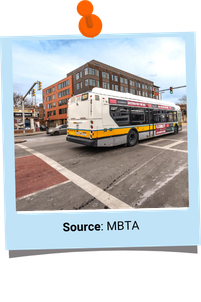
 | Transit Signal Priority | Transit signal priority (TSP) deployed at three Boston, Massachusetts intersections reduced bus waiting time at red light signals by 21%. TSP resulted in 8% faster travel times. |
 | TSP Data for Signal Retiming | Data collected from a CV TSP application on an 11-mile corridor in Salt Lake County, Utah was used to retime traffic signals, helping to improve bus run-time reliability by up to 2.7%. |
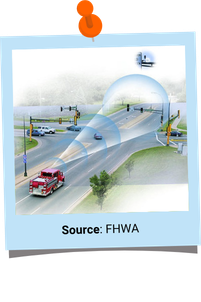
 | V2X Emergency Vehicle Preemption | Vehicle-to-Everything (V2X) EVP deployed in Seminole County, Florida led to average response time reductions of 90 seconds. and annual maintenance costs are expected to decrease by $200,000. |

Emergency Vehicle Preemption
PROBLEM
To reach the scene of an incident, first responders may need to drive through congested intersections and proceed through red traffic signals. They rely on sirens and flashing lights as alerts, which can confuse nearby drivers and result in response delays or even collisions.
TECHNOLOGY
When emergency vehicle preemption systems detect light, audio, or radio signals from emergency vehicles, they override normal traffic signal operations. This gives approaching emergency vehicles a priority green signal, allowing them to more quickly respond to incidents.
BENEFITS
Across southwestern Pennsylvania, 37 emergency preemption systems triggered by sound were installed, which helps reduce emergency response time by 14 to 23% (2023-B01807).

Connected Vehicle School Buses
PROBLEM
School buses often travel long and complex routes with numerous stops to transport students to and from school. Stops, whether for loading and unloading students or at traffic signals, impact mobility, safety, and fuel consumption.
TECHNOLOGY
The Fulton County School System (FCSS) in Alpharetta, Georgia deployed traffic signal priority at 62 intersections. When a CV-equipped bus approaches a CV-equipped intersection, the signal phase shifts to green, allowing the school bus to pass through the intersection without stopping.
| “Less time on the road and fewer bus stops equates to direct safety and mobility benefits for the bus driver, students, parents, nearby motorists, and FCSS [3].” |
BENEFITS
The combined results for the two FCSS school buses showed a 13.3% decrease in travel time, an 18% increase in speed, and a 40.4% decrease in the number of stops (2023-B01804).
Transit Signal Priority
PROBLEM
Up to 50% of transit delay consists of waiting at red lights in signalized
intersections [4]. These signal-related delays reduce bus reliability and
make travel times longer and less predictable for riders.
TECHNOLOGY
The Massachusetts Bay Transportation Authority (MBTA) and City of
Boston worked with a traffic signal vendor that uses machine-learning
TSP technology to track and predict transit bus locations, enabling the
system to prioritize green signals for the bus as it approaches a TSP
equipped intersection.
| “The MBTA and the City of Boston aim to improve bus speed and reliability citywide with a major transit signal priority upgrade as a part of the MBTA’s Better Bus Project. [4].” |
BENEFITS
After a year of deployment across the three intersections, buses spent an average of 21% less time waiting at red lights, indicating 8% faster travel time for buses (2025-B01960).
TSP Data for Signal Retiming
PROBLEM
As growing travel demand outpaces available road space, increasing congestion is creating significant hurdles for public transit. Buses are frequently delayed at traffic signals and struggle to stay on schedule, which ultimately makes the service less reliable for commuters.
TECHNOLOGY
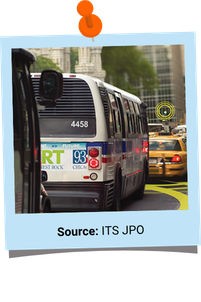
A project in Salt Lake City developed a TSP algorithm based on CV technology that enables real-time communication between traffic signals and buses, providing access to real-time signal status and bus travel information. This meant signals could be retimed to better align green signals with bus movements.
BENEFITS
After signal retiming, bus travel times had a 11.7% reduction in northbound (NB) travel times and a 2.3% reduction in southbound (SB) travel times. Bus time reliability also improved after signal retiming by 2.7% (NB) and 1.2% (SB) (2023-B01721).
| “After signal retiming, TSP service was activated during the red interval, which resulted in less stop time at intersections. Therefore, both travel and running time were reduced after signal retiming [5].” |
V2X Emergency Vehicle Preemption
PROBLEM
Emergency vehicles may face delays at congested intersections because line-of-sight or audible emergency vehicle preemption systems prevent vehicles from requesting signal priority until they are very close to the intersection. Ultimately this causes delays and slower response times.
TECHNOLOGY
Florida DOT (FDOT) deployed a dedicated short-range communication (DSRC)-based V2X solution to enhance the effective radius from which an emergency vehicle could place a request for preemption.
BENEFITS
The FDOT pilot in Seminole County found that by implementing this V2X system, average response times improved by approximately 90 seconds, and annual maintenance costs are expected to decrease by $200,000 (2025-B01994).
| “The Department is spreading the word about the potential cost savings and improved performance compared to other options ...Performance achieved; under budget; with lower O&M; and it is scalable [6].” |
SAMPLE COSTS: TRAFFIC SIGNAL PRIORITY AND PREEMPTION
| $5,000 per Vehicle for Intersection Priority | An Atlanta-area deployment of intersection priority technology on school buses cost $5,000 per vehicle and $5,000 per intersection. This technology and associated signal priority algorithms support multiple use cases, including signal priority for emergency vehicles. (2023-SC00546). |
| $4,000 per Intersection Emergency Preemption | Texas DOT (TxDOT) provided the estimated cost of selected traffic incident management components based on recent TxDOT and municipal project cost estimates. This includes $4,000 per traffic signal for emergency vehicle preemption (2022-SC00523). |
| Between $600,000 and $750,000 for an EVP System | The City of San Jose implemented a city-wide EVP system by upgrading and integrating fleet tracking systems with a network of traffic signal controllers for between $600,000 and $750,000 (2018-SC00407). |
LESSONS LEARNED: TRAFFIC SIGNAL PRIORITY AND PREEMPTION
 | In Tennessee, 1,655 traffic signals were ranked based on the results of a performance evaluation. Machine learning can fine-tune the weighting of different ranked choice factors in the calculation of signal priority and refine the algorithm (2023-L01170). |
 | The North Carolina Department of Transportation (NCDOT) and North Carolina Emergency Management partnered to develop the real-time flood warning system FIMAN-T (Flood Inundation Mapping and Alert Network for Transportation), which leverages real time 3D inundation mapping with Light Detection and Ranging (LiDAR)-derived roadway elevation layers to compute flooding depths over roadways. Key lessons learned from using the tool include (2023-L01195):
|
 | The Weather-Responsive Management Strategies (WRMS) initiative of FHWA’s Every Day Counts program promotes use of road weather data from mobile and connected vehicle technologies to support traffic and maintenance management strategies during inclement weather. WRMS can mitigate impacts of flooding events through preparation and prediction efforts that build and leverage data, tools, and relationships. Key lessons learned from flood events include (2021-L01024):
|
REFERENCES
Federal Highway Administration. “Active Traffic Management: Approaches: Active Transportation and Demand Management - FHWA Operations” Aug. 2023. [Online]. Available: ops.fhwa.dot.gov/atdm/approaches/atm.htm .
Federal Highway Administration. “Traffic Signal Timing Manual: Chapter 9 — Advanced Signal Timing Topics.” Apr. 2021 [Online].
Available: https://ops.fhwa.dot.gov/publications/fhwahop08024/chapter9.htmApplied Information & Kimley Horn. “School Bus Priority: Connected Vehicle Student Safety Pilot Program.” Oct. 2022. [Online].
Available: https://appinfoinc.com/wp-content/uploads/2022/10/school-bus-priority-pilot-overview.pdf.Massachusetts Bay Transportation Authority. “MBTA and City of Boston Announce Partnership to Improve Bus Reliability by Expanding Transit Signal Priority City-wide After Successful Test Along Brighton Avenue.” Jan. 2025. [Online]. Available:
https://www.mbta.com/news/2025-01-27/mbta-and-city-boston-announce-partnership-improve-bus-reliability-expanding-transit.Wang, Q., Yang, X. T., and Yuan, Y. “Transit Signal Progression Algorithm for Supporting Redwood Road Transit Signal Priority (TSP).” Oct. 2020. Report No. UT-20.16. [Online]. Available: https://drive.google.com/file/d/10-AlujqlbspZZObah_mfdbPacZUzDlO/view.
National Operations Center of Excellence (NOCOE). “FDOT NTCIP Based Emergency Vehicle Preemption.” Aug. 2025. [Online]. Available: https://www.transportationops.org/case-studies/fdot-ntcip-based emergency-vehicle-preemption.