2024 Executive Briefing
 BRIEFING HIGHLIGHTS
- Trucks with Automatic Emergency Braking (AEB) systems have roughly 40 percent fewer crashes.
- Trucks with lane departure warning systems have roughly 21 percent fewer crashes.
- Sixty-seven (67) percent of truck drivers surveyed reported real-time parking information systems significantly improved their ability to find parking and comply with Hours of Service (HOS) regulations.
Introduction
The transportation and logistics industry is undergoing a transformative shift with the integration of Intelligent Transportation Systems (ITS) into commercial vehicle operations. These advanced systems leverage cutting-edge technologies to provide significant benefits for the trucking industry and its drivers. Among the most widely adopted ITS technologies for commercial vehicle applications are Advanced Driver Assistance Systems (ADAS) and smart parking management systems. While both aim to enhance safety, efficiency, and convenience in trucking operations, they address different aspects of the driving experience.
ADAS includes features such as Forward Collision Warning (FCW), Lane Departure Warning (LDW), Pedestrian Collision Warning (PCW), and Automatic Emergency Braking (AEB). These technologies are designed to minimize crash risks while enhancing driver comfort, improving operational efficiency, reducing fatigue, and facilitating navigation through complex traffic conditions. Additionally, smart parking systems utilize real-time data and advanced algorithms to assist drivers in quickly locating suitable parking, thereby minimizing time spent searching for spaces and optimizing use of available areas at busy truck stops.
When used together, these applications can streamline the entire journey for truck drivers. ADAS promotes safe and efficient driving, while truck parking information systems provide convenient availability of secure parking, reducing downtime and optimizing routes. Together, these systems foster safer, more efficient, and sustainable operations for commercial motor vehicles.
Benefits

With improved situational awareness and optimized driving behavior, empirical data show that ADAS can prevent accidents by assisting drivers in maintaining control of their vehicles and responding to potential hazards. A recent study conducted by the Virginia Tech Transportation Institute in 2024 for the United States Department of Transportation (USDOT) Federal Motor Carrier Safety Administration (FMCSA) Research Forum provided empirical data that trucks equipped with ADAS had lower crash rates compared to trucks without these technologies over a 3-year study period.
- Trucks with FCW (no AEB) were associated with about a 30 percent lower crash rate.
- Trucks with AEB (+FCW) were associated with about a 40 percent lower crash rate.
- Trucks with LDW were associated with a 21 percent lower crash rate (2024-B01891).
The adoption of ADAS is growing. According to data from the USDOT's “Tech-Celerate Now” Program, both carriers and truck drivers tend to increase adoption levels appreciably during their first year of exposure with truck drivers adopting at a higher rate than carriers. Overall, averaged across all ADAS technologies, drivers and carriers reported an eight and four percent increase in widespread adoption, respectively (2024- B01888).
Similarly, truck parking management systems are gaining traction. Smart Parking systems deliver real-time data to onboard monitoring systems, alerting drivers to available parking spaces at truck stops, rest areas, and designated areas. This capability helps drivers locate legal and safe parking spots, ensuring compliance with Hours of Service (HOS) regulations and reducing the risk of violations while enhancing overall road safety. A survey of truck drivers on I-94 in Minnesota revealed that 67 percent of those receiving real-time parking information through onboard computer applications reported a significant improvement in their ability to find parking (2019-B01340).
Integration of truck parking information management systems with commercial vehicle operations over the last several years have contributed to improved safety through enhanced driver fatigue management, and reduced infrastructure costs through better utilization of existing parking capacity with benefit-to-cost ratios ranging from 4:27:1 to 7:1 (2019-B01339, 2018- B01256).
Costs
Financial concerns are a primary factor in the decision for commercial motor vehicle executives to purchase ADAS technologies.
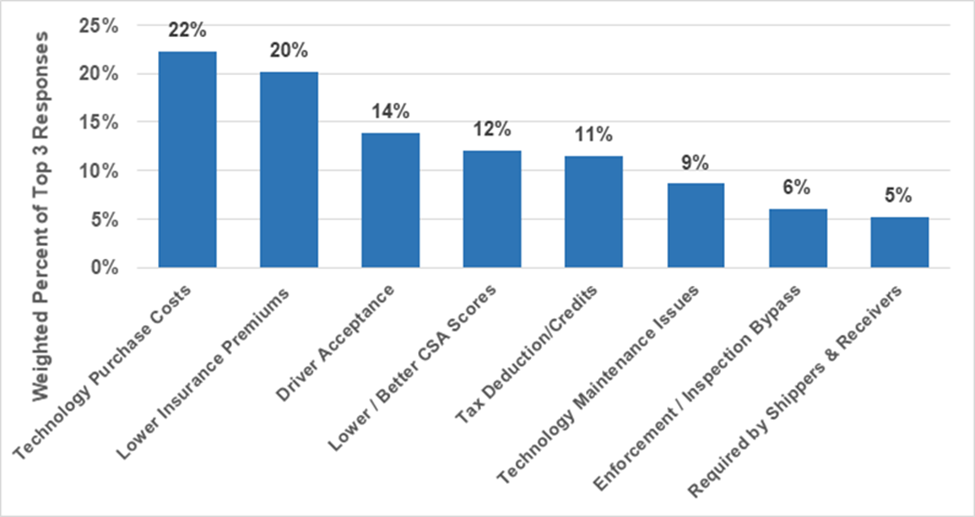
Depending on the number of ADAS features installed and fleet negotiating power, integrated safety systems can cost up to $5,000 per truck for systems limited to AEB, to $8,200 per truck for systems that support multiple functions including AEB, Adaptive Cruise Control, Lane Keeping Assist, and Onboard Safety Monitoring Systems (2024-SC00560) (2024-SC00561).

For Smart Parking applications, infrastructure is the primary cost factor. In Colorado, a statewide parking management system designed to cover truck stops on three major freight corridors, including I-25 (917 truck parking spaces), I-70 (2,004 truck parking spaces), and I-76 (587 truck parking spaces) for operations in 2019 was implemented for an estimated total capital cost of roughly $9 million (2018- SC00397). Ground-up cost estimates for specific sites can vary widely ranging from $2,000 to $30,000 per space depending on technology, location, level of cooperation among public and private entities, and deployment strategy (2020-SC00462). In addition, the cost to implement a real-time parking information system designed to disseminate traveler information to truckers has been estimated at $391,000 per rest area.
Success Story: ADAS
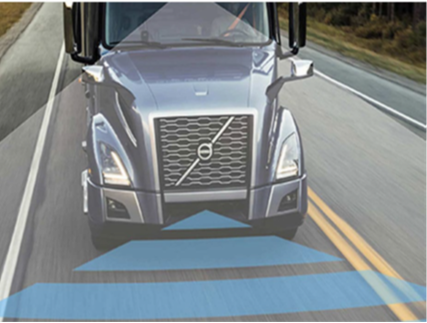
Front crash prevention systems, namely FCW and AEB, monitor the road conditions ahead using radar and/or video camera sensors. FCW systems typically sound an audible alert if a front collision is likely, allowing the driver to begin an avoidance maneuver. AEB systems, which generally include FCW functionality, apply the vehicle’s foundation brakes to prevent or mitigate a forward impact if the driver does not intervene.
While FCW and AEB systems have been shown to reduce front-to-rear crash rates for passenger vehicles, less is known about the effectiveness of AEB in large trucks. Therefore, this study sought to better understand their effectiveness as countermeasures for crashes with large trucks.
METHODOLOGY
Data on Class 8 trucks operating on limited-access highways during 2017–2019 were obtained from SmartDrive Systems. All 62 carriers in the study operated trucks both with and without front crash prevention technologies, and many operated trucks with only one of the front crash prevention systems. Detailed data on exposure measures and crash circumstances were extracted from video footage by both automated means and manual coding. Crash rates were compared by front crash prevention technology (FCW, AEB, neither) for all police-reportable crashes and for relevant crash types.
FINDINGS
FCW was associated with a statistically significant 22 percent reduction in the rate of all police-reportable crashes per vehicle miles traveled of large trucks, and a significant 44 percent reduction in the rate of rear-end crashes. AEB was also associated with significant reductions—12 percent overall and 41 percent for rear-end crashes. On average, speed was reduced by over half between the time of the intervention and impact for both systems (2020-B01487).
Success Story: Smart Parking
Smart Parking systems collect truck parking availability information and communicate it in real-time to active drivers. Parking data collected from parking facilities is sent to an information processing center and then converted into parking availability information which is then posted on roadside dynamic message signs (DMS) and 511 systems, and made available to mobile devices and traveler information websites. Data generated by Smart Parking systems can be leveraged by Truck Parking Information and Management System (TPIMS) data exchange programs to improve truck parking availability and efficiency nationwide.
With more than 11 percent of truck crashes associated with driver fatigue, safe truck parking has emerged as a priority for both carriers and state agencies. Available studies suggest the problem is not simply a shortage of rest areas but that truckers have trouble finding available spaces. Field studies indicate that 83 percent of drivers spend more than 30 minutes searching for parking, and when unable to find suitable parking before reaching their hours-of-service limits, are often forced to park unsafely on highway ramps, roadway shoulders, or at abandoned facilities [1][2].
In the Midwest, several projects implemented through the TPIMS program have become operational. These systems that provide advanced notification of real-time parking availability information have improved performance of both truck drivers and parking facility operators, effectively limiting driver fatigue, increasing highway safety, and maximizing use of existing facilities.
In 2019, Smart Parking systems implemented in conjunction with a TPIMS in Minnesota resulted in several positive outcomes. Truck drivers across the state experienced significant improvements in their ability to locate available parking, particularly along critical freight corridors. By providing real-time information through dynamic signage and mobile applications, these systems helped drivers find parking efficiently, reducing time spent searching for spaces and improving overall safety. Local media noted that drivers were excited about the system and felt it significantly alleviated the stress associated with finding parking, especially in high-traffic areas. Overall, the TPIMS program has been a success, contributing to both road safety and logistical efficiency in the trucking industry [3].
References
- MAASTO Truck Parking Survey Analysis – May 2018. American Transportation Research Institute. Arlington, VA. May 2018. https://trucksparkhere.com/wp-content/uploads/2018/09/Phase-2- MAASTO-Truck-Parking-Survey-Report_OnlineVersion.pdf
- MAASTO TPIMS Project: Concept of Operations. 2016. https://trucksparkhere.com/wp-content/uploads/2017/07/MAASTO-TPIMS-ConOps.pdf
- “TPIMS Project Honored by Transportation Industry,” TrucksParkHere.com, April 7, 2020. https://trucksparkhere.com/april-7-2020-tpims-project-honored-by-transportation-industry