Quick glance at benefits and costs from ITS for incident response deployments around the United States.
WHAT ARE ITS DEPLOYMENTS FOR INCIDENT RESPONSE?
Traffic incidents are unplanned roadway events impacting normal traffic flow. These incidents increase the likelihood of secondary crashes and pose a threat to the safety of incident responders and the traveling public. Incidents affect travel reliability, commerce, and transportation system performance [1]. By using Intelligent Transportation Systems (ITS) technologies, first responders can improve outcomes by reducing impacts on traffic flow and the probability of secondary incidents.
EXAMPLE ITS FOR INCIDENT RESPONSE USE CASES AND BENEFITS
Click on each use case below from recent ITS for incident response deployments, based on ITS project evaluations contained in the ITS Deployment Evaluation Database.
| Use Case | Example Benefit | |
|---|---|---|
 | Emergency Vehicle Preemption | In southwestern Pennsylvania, 37 emergency preemption systems triggered by sound were installed as part of a regional traffic signal program and helped reduce emergency response time by 14 to 23%. |
 | Incident Connectivity Platform | Georgia Department of Transportation’s (GDOT) use of a cloud-based emergency call-taking app helped reduce the time to locate stranded motorists by 85% over the course of a 3-month pilot program. |
 | Trauma Center Notification | The TraumaHawk smartphone app directly connects emergency responders to hospital trauma teams and reduced overall trauma center notification time by 12 minutes versus traditional methods. |
 | Unmanned Aircraft Systems | The Washington State Patrol found that unmanned aircraft systems (UAS) can reduce road closure times by 75% when used for traffic incident management (TIM). |
 | Variable Message Signs | The Utah Department of Transportation (UDOT) found that variable message signs (VMS) increased traffic diversion rates by 18% during incidents. |

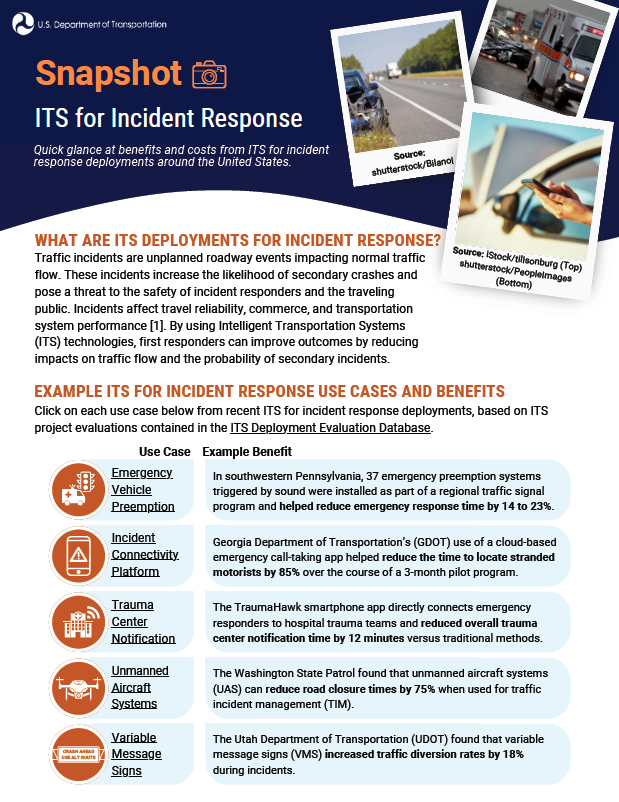
Emergency Vehicle Preemption
PROBLEM
To reach the scene of an incident, first responders may have to drive through congested intersections where their sirens and flashing lights can cause confusion for nearby motorists, resulting in delays and potential collisions.
TECHNOLOGY
When emergency vehicle preemption systems detect light, audio, or radio signals from emergency vehicles, they override normal traffic signal operations to give approaching emergency vehicles priority to more quickly respond to incidents.
BENEFITS
| “Using Intelligent Transportation Systems to provide emergency vehicles a green light at intersections can reduce driver confusion, reduce conflicts, and improve emergency response times [2].” |
Across southwestern Pennsylvania, 37 audible emergency preemption systems were installed, which helps reduce emergency response time by 14 to 23% (2023-B01807).

Incident Connectivity Platform
PROBLEM
When stranded motorists in Georgia call 511 for assistance, operators are often forced to rely on the motorist's directions when trying to locate them in locations without sufficient camera coverage.
TECHNOLOGY
Georgia DOT partnered with a private vendor to develop a cloud-based emergency call taking app with geo locating and image uploading features that provides stranded motorists with more tools to identify their location to 511 operators.
BENEFITS
When used as the first means of locating stranded motorists during a three month pilot period, Georgia’s 511 app reduced average dispatch time from 23 minutes to 3 minutes, which represents an 85% decrease in dispatch time (2022-B01616).
| “The [platform] quickly provides accurate location information, instead of relying on the motorist’s knowledge or requiring video or vehicledetection data to be reviewed [3].” |
Trauma Center Notification
PROBLEM
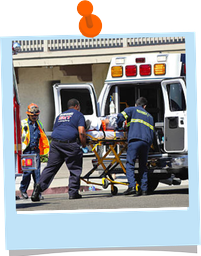
Hospital trauma teams often have little to no advance notice about the condition of incoming car crash victims, which makes it more difficult for these teams to properly care for patients.
TECHNOLOGY
The State of Iowa developed TraumaHawk, a smartphone app for law enforcement and first responders to connect pre-hospital emergency care to hospital trauma teams. By allowing first responders to generate and send reports with vital collision information to the receiving trauma center, TraumaHawk can help to improve patient outcomes.
BENEFITS
| “Utilizing TraumaHawk to identify serious crashes that likely have complex injuries remotely provides trauma teams with significantly more time to prepare for incoming patients than the conventional ambulance crew notification [4].” |
During a year-long testing period, TraumaHawk gave hospitals advance notice of a patient’s condition faster than traditional methods 63% of the time, leading to an average overall notification time improvement of 12 minutes (2024-B01865).
Unmanned Aircraft Systems
PROBLEM
When roadway crashes occur, every minute between the moment of the crash and its clearance increases the risk of secondary crashes and prolongs traffic. Efficient crash scene documentation saves time for both investigators and motorists and reduces these risks.
TECHNOLOGY
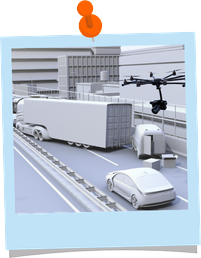
UAS, also known as drones, are aircraft that do not carry a human operator. UAS can provide aerial footage, collect data, and deliver payloads. UAS have proven to be cost effective when implemented to document crash scenes.
BENEFITS
In 2018, the Washington State Patrol conducted a pilot program deploying 125 UAS. Over the course of 9 months, they found a 75% reduction in road closure times when UAS were used for crash documentation, leading to a total of $4,210,500 saved (2023-B01704).
| “UAS holds great promise for TIM applications, improving safety, relieving congestion, and reducing the economic impacts of roadway incidents [5].” |
Variable Message Signs
PROBLEM
When incidents occur, it is difficult to communicate traffic information to drivers in real time, which leads to traffic congestion on the highway, higher risks of secondary crashes, and more difficult conditions for first responders.
TECHNOLOGY
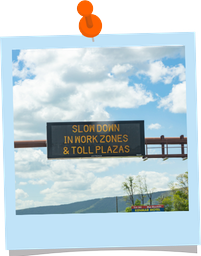
UDOT deployed VMS on I-15 to improve driving outcomes, including in emergency situations. VMS enables road operators to communicate information about incidents to drivers upstream of the emergency.
BENEFITS
Officials in Utah found that the activation of VMS messages increased diversion rates by 18%. This decreased congestion and improved the speed at which drivers reached their destination (2024-B01853).
| “VMS messages provide critical information in the hopes of informing route choices for drivers [6].” |
SAMPLE RURAL ITS DEPLOYMENT COSTS
| An Atlanta area deployment of intersection priority technology on school buses cost $5,000 per vehicle and $5,000 per intersection. This technology and associated signal priority algorithms support multiple use cases, including signal priority for emergency vehicles. (2023-SC00546). | $5,000 per |
$72,000 | A study of VMS in Michigan found that the overall one-time cost of a VMS is $72,000. The annual operation cost is $2,300 with an expected service life of 15 years (2023-SC00540). |
| UAS have proven to be cost effective when implemented as part of TIM deployments, especially for aerial images. The Washington State Patrol documented 125 UAS deployments during their 2018 pilot program and found the operational cost for a UAS is $20 per hour (2022-SC00522). | $20 per hour |
| $4,000 per Intersection Emergency Preemption | Texas DOT (TxDOT) provided the estimated cost of selected traffic incident management components based on recent TxDOT and municipal project cost estimates. This includes $4,000 per traffic signal for emergency vehicle preemption as well as other costs listed in the table below (2022-SC00523). |
| Device | Initial Capital Cost | Annual Operations & Maintenance Cost |
|---|---|---|
| Vehicle Detection and Cameras | $9000/detection device | $500 |
| Automated Incident Detection System | $1,000/camera | $100 |
| Emergency Vehicle Preemption | $4,000/traffic signal | $250 |
| Dedicated Incident Responders | $50/hour | |
| Incident Response Vehicles | $60,000/vehicle | $3,000 |
| Traffic Management Center Employees | $50/hour | |
| Travel Information System Integration | $50,000/integration | $1,000 |
| Connected Vehicle Communication Hardware and Software | $5,000/location | $500 |
| Scene Photo Sharing System | $200,000/system | $15,000 |
| VMS | $125,000/sign | $5,000 |
REFERENCES
Federal Highway Administration. “Welcome to Traffic Incident Management.” Apr. 2025. [Online]. Available:
https://ops.fhwa.dot.gov/tim/.D’Andrea, D. “Regional Traffic Signal Program: Cycle 3 Summary.” Mar. 2023. [Online]. Available:
https://www.govinfo.gov/content/pkg/GOVPUB-TD2-PURL-gpo150740/pdf/GOVPUB-TD2-PURL-gpo150740.pdf.Jackson, D. “Georgia turns to Carbyne to enhance location information for statewide transportation system” Aug. 2021. [Online]. Available: https://urgentcomm.com/operations/georgia-turns-to-carbyne-to-enhance-location-information-for-statewidetransportation-
system.McGehee, D. V., Buresh, C., Roe, C. A., and Harland, K. “Project TraumaHawk: Improving Patient Outcomes Through Photographic Trauma Site Documentation Phase IV: Regional Expansion” Jun. 2021. [Online]. Available:
https://rosap.ntl.bts.gov/view/dot/73660.Carrick, G. and Burgess, L. “Unmanned Aircraft Systems for Traffic Incident Management” Feb. 2022. [Online]. Available:
https://ops.fhwa.dot.gov/publications/fhwahop20063/fhwahop20063.pdf.Schultz, G. G., Davis, M., Hill, A., and Snow, G. L. “Effectiveness of ITS on Utah Roadways” Dec. 2023. [Online]. Available:
https://rosap.ntl.bts.gov/view/dot/72910.