ITS for Work Zone Safety
Road construction and maintenance workers are critical to maintaining safety and efficiency on the nation’s roadway network, from fixing hazardous or outdated infrastructure to helping install the latest technologies to improve safety and efficiency. Each day, these workers contend with major safety challenges while keeping Americans moving safely and efficiently. According to the National Highway Traffic Safety Administration (NHTSA) Fatality Analysis Reporting System (FARS), in 2024 there were 763 traffic crashes involving fatalities in work zones, resulting in 850 fatalities [1].
Fatal Work Zone Crash Trends
The growth of fatal crashes in work zones has increased more rapidly than the overall growth in fatal crashes in the United States (U.S.). Between 2010 and 2024, fatal work zone crashes increased by 46 percent compared to 20 percent increase in overall fatal roadway crashes during the same period. The following chart summarizes the trend of increasing fatal work zone crashes since 2010, broken down by work zone type.
Fatal Work Zone Crashes by Type of Work Zone
Source: Fatality Analysis Reporting System (FARS). Data pulled June 2026.
Unfortunately, hundreds of fatal work zone crashes happen across the U.S. every year. The following map illustrates all fatal work zone crashes that occurred throughout the U.S. in 2024 using FARS data [1]. Each of these 2024 fatal work zone crashes are plotted on the following map. The color of each point corresponds to the work zone type (e.g., construction, maintenance, etc.) the crash occurred in. Hover over each point to reveal specific location and crash information.
2024 Fatal Work Zone Crashes by Work Zone Type |
Source: Fatality Analysis Reporting System (FARS). Data pulled June 2026.
A disproportionate number of fatal work zone crashes occur on high-speed roads. In 2024, 45 percent of fatal work zone crashes occurred on interstates, freeways, or expressways compared to only 16 percent overall fatal vehicle crashes during the same period [1]. The map below shows the distribution of fatal work zone crashes by roadway type across the U.S.
2024 Fatal Work Zone Crashes by Roadway Type |
Source: Fatality Analysis Reporting System (FARS). Data pulled June 2026.
ITS Work Zone Technologies
Intelligent Transportation Systems (ITS) technologies are one tool to help communities across the U.S. to address the challenge of work zone crashes and fatalities. Browse below to learn about some of these helpful technologies.
Portable Variable Speed Limit Systems (PVSL) 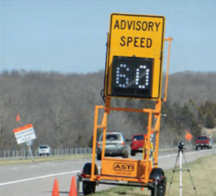
| 
|
Queue Warning Detection Systems 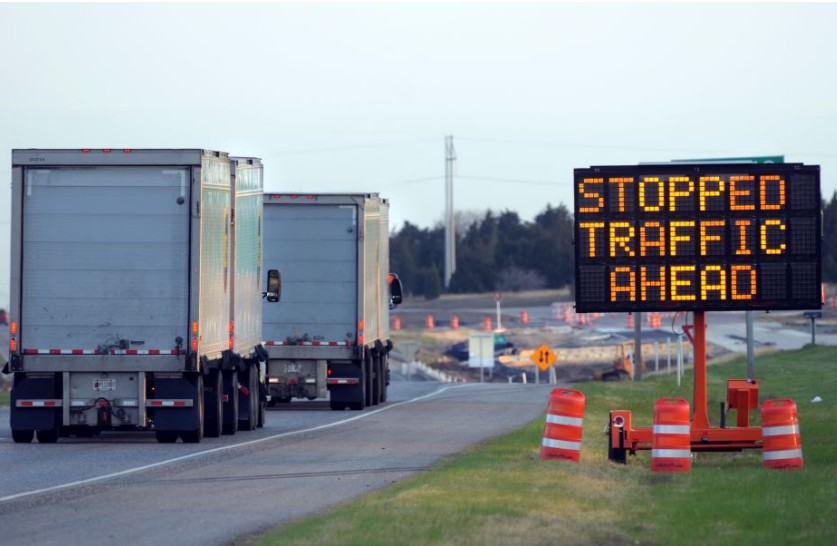
| Automated Work Zone Speed Enforcement 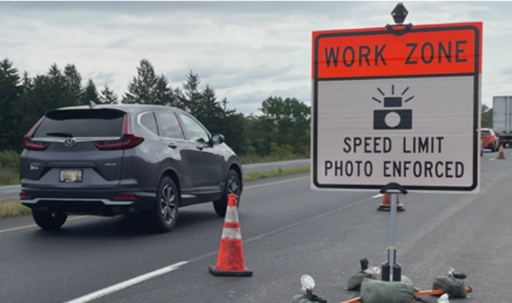
|
Additional Popular ITS Work Zone Technologies include:
- Portable dynamic message sign (DMS)
- Portable closed-circuit television (CCTV)
- Travel time system
- Portable traffic monitoring
- Dynamic lane merge system
- Temporary ramp metering
- Intrusion alarm
- Temporary traffic signal
ITS Work Zone Technology Adoption
The ITS Deployment Tracking Survey, conducted approximately every three years, measures the deployment of ITS among freeway, arterial, and transit management agencies in a cross-section of metropolitan, smaller urban, and rural areas. Freeway agencies are largely comprised of State Department of Transportation (DOT) districts, while arterial agencies are both State DOT districts and local (e.g., city, town, county) agencies. Because 96 percent of local arterial agencies do not deploy ITS at work zones, the data presented for arterial agencies only represent deployments by the State DOT districts managing arterials.
The survey tracks adoption of ITS for a variety of use cases, including ITS technologies used to enhance safety in work zones. The following chart shows adoption rates of specific technologies for both freeway agencies (orange) and State DOT districts managing arterials (blue). Freeway agencies tend to adopt ITS at work zones at a higher rate than State DOT districts managing arterials.
Work Zone Technology Adoption by Freeway Agencies and State DOTs Managing Arterials Source: USDOT ITS Joint Program Office (JPO) Deployment Statistics |
Case Studies
State and local agencies around the country have found success implementing work zone safety technologies. ITS deployments in Alaska, Oregon, and Illinois demonstrate how applied ITS may lead to quantifiable benefits in addressing major challenges in work zone safety.
Portable Variable Speed Limit (Alaska):
To address work zone crashes due to a combination of increased tourism and increased construction on the roads during the summer, the Alaska Department of Transportation and Public Facilities deployed a Portable Variable Speed Limit System (PVSL) along a construction zone with the aim of decreasing speeding. After deployment, the percentage of vehicles speeding decreased from 21.8 percent to 9.4 percent, representing a 57 percent decrease. You can learn more about this case study in the Benefits, Costs and Lessons Learned Database. | Decrease in Speeding Vehicles before and after implementing Portable Variable Speed Limits Source: Alaska DOT |
Truck-mounted Radar Speed Signs (Oregon):
The Oregon Department of Transportation (ODOT) installed truck-mounted radar speed signs to measure their impact on speeding while engaging in four different common roadside maintenance activities—re-lamping, sweeping, vactoring (cleaning with a powerful vacuum truck), and spraying. They found that for each of these activities, traffic speeds decreased between 5 percent and 23 percent when the truck-mounted radar speed signs were used. You can learn more about this case study in the Benefits, Costs and Lessons Learned Database. | Decreases in Speed for Different Activities when using Truck-mounted Radar Speed Signs Source: Oregon DOT |
Work Zone Queue Warning System (Illinois):
The Illinois Department of Transportation (Illinois DOT) installed a queue warning system aiming to decrease crashes work zones. They found an 11 percent reduction in injury crashes and a nearly 14 percent reduction in queueing crashes after implementation of the queue warning system. This was despite a 52 percent increase in the number of days when temporary lane closures were implemented. You can learn more about this case study in the Benefits, Costs and Lessons Learned Database. | Reduction in Crashes after Queue Warning System Implemented Source: Illinois DOT |
ITS Benefits - Work Zone Safety
Benefits of ITS deployments are recorded and stored in the ITS Benefits database, part of the larger Benefits, Costs, and Lessons Learned (BCLL) databases maintained by the ITS Joint Program Office (JPO). The ITS Benefits database contains records on the benefits of ITS according to goals identified by the U.S. Department of Transportation, such as safety, mobility, efficiency, productivity, and customer satisfaction.
The following examples of work zone ITS benefits are among the many ITS Benefits located in the Benefits section of the BCLL database.
ITS Costs - Technologies in Work Zones
Costs of ITS rural deployments are recorded and stored in the ITS Costs database, part of the larger BCLL databases maintained by the ITS JPO. A few examples of the costs related to ITS deployments in work zones are highlighted below.
A Smart Work Zone (SWZ) System Implemented During an Interchange Reconstruction Project on I-35 in Kansas Cost Approximately $1.65 Million (2021-SC00477). Smart work zones are becoming increasingly common in the United States. According to the National Work Zone Safety Information Clearinghouse, a smart work zone deploys ITS components to dynamically manage the work zone, such as queue warnings, variable speed limits, and more. The components of this specific smart work zone in Kansas are visualized on the right. Advanced Queue Detection Systems Installed at Four Work Zones in Nebraska Were Estimated To Cost $166,225 per Work Zone for a 6-Month Project on I-80 (2023-SC00549). Missouri DOT’s V2V-Enabled Truck Mounted Attenuator Leader-Follower System Was Estimated to Cost $301,485 Per Unit, Considering System Integration, Maintenance and Support, and Training Costs (2024-SC00551). The Estimated Technology. Procurement and Deployment Cost of an Automated Truck-Mounted Attenuator System for Mobile Work Zone Operations was $295,000 (2023-SC00537). The Nine-Month Capital and Maintenance Cost for Driveway Assistance Devices in One-Lane, Two-Way Work Zones in Ohio Was Estimated as $20,700 (2023-SC00538). | Smart Work Zone System Cost Source: USDOT ITS JPO Cost data adjusted to 2020 dollars. |
Additional Resources
The National Work Zone Safety Information Clearinghouse 
The National Work Zone Safety Information Clearinghouse was created through a cooperative agreement between the Federal Highway Administration (FHWA) and American Road & Transportation Builders Association (ARTBA) for the purpose of assembling and disseminating information relating to improvement of roadway work zone safety. The clearinghouse provides the transportation construction industry and the general public with comprehensive information to improve motorist, worker and pedestrian safety in roadway work zones. |
Work Zone Data Exchange (WZDx) 
The Work Zone Data Exchange (WZDx) Specification enables infrastructure owners and operators (IOOs) to make harmonized work zone data available for third party use through the recent work zone standard. The objective is to make travel on public roads safer and more efficient through ubiquitous access to data on work zone activity. The project aims to get data on work zones into vehicles to help automated driving systems (ADS) and human drivers navigate more safely.
|
Federal Highway Administration (FHWA) Work Zone Management Program 
The FHWA Work Zone Management program develops and deploys solutions and strategies that enable agencies to incrementally and continuously improve work zone management to minimize traffic delays and maintain the safety of all road users (motorists, bicyclists, pedestrians) and workers. This is achieved through a combination of applied research, knowledge and technology transfer, stakeholder engagement, and performance management.
|
References
- National Highway Traffic Safety Administration, "Fatality and Injury Reporting System," [Online]. Available: https://www-fars.nhtsa.dot.gov/Main/index.aspx