2025 Executive Briefing
BRIEFING HIGHLIGHTS
- Cutting-edge ITS technologies allow transit agencies to improve service quality, reliability, and efficiency.
- New solutions driven by artificial intelligence and cloud computing can modernize existing systems by automating decision-making processes.
ITS deployments targeted and scaled to meet specific user needs can modernize transit operations to efficiently and effectively connect travelers with their destinations.
Introduction
Transit agencies connect Americans with employment, health care, education, shopping, recreation, and other services in ways that strengthen our communities, spur economic development, and boost the wellbeing of people, families, and communities.
Innovative intelligent transportation system (ITS) solutions, such as automated vehicles, connected vehicle technologies, novel data standards, and artificial intelligence (AI) and machine learning (ML), are transforming the way agencies provide transit services. These solutions can touch on any aspect of transit service—whether improving operations on the back end, augmenting the capabilities of vehicles in service, or improving the traveler experience. Improving the efficiency, capabilities, and quality of transit service lets travelers benefit from safer and more reliable mobility options.
This briefing identifies several recent deployments transforming the way that transit is provided across the country, highlighting the benefits and outcomes, lessons learned, and specific cost information. The examples covered in this briefing range from established ITS solutions, such as transit signal priority (TSP), bus rapid transit (BRT), and computer-aided dispatch/automatic vehicle location (CAD/AVL), to novel innovations such as AI, ML, and connected vehicle solutions leveraging cutting-edge technology and software. Transit agencies of all sizes may see benefits from modernizing their fleets, services, and operations.
Advancing the development and deployment of innovative transit solutions using ITS technologies is a priority for USDOT, the ITS Joint Program office (JPO), and the Federal Transit Administration (FTA). A range of programs, including ITS JPO’s ITS4US Deployment Program, FTA’s Accelerating Innovative Mobility (AIM) Initiative, FTA’s Integrated Mobility Innovation (IMI), and others have funded pilots and technology prototypes to facilitate adoption of next-generation transit solutions for all Americans.
Benefits
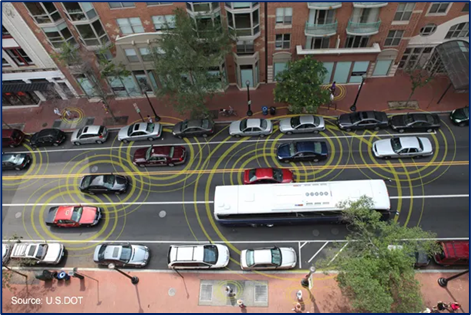
The benefits from implementing innovative ITS solutions in transit systems may be just as varied as the technologies themselves. The table below summarizes benefits for technologies and services including: vehicle-to-everything (V2X) technologies that enables communication between vehicles, infrastructure, and connected pedestrians; data standards such as the General Transit Feed Specification (GTFS) to facilitate sharing of transit data; CAD/AVL to monitor vehicle location; TSP to modify signal phase timings for more efficient transit vehicle service; BRT, offering faster and more reliable service; automated vehicles to improve safety and increase mobility; AI/ML to streamline decision-making and automatically improve operations over time; first-mile/last-mile (FMLM) service to connect travelers with fixed-route transportation networks; and partnerships with transportation network companies (TNCs) that offer ride-hailing services to supplement fixed-route transit.
Table 1: Transit Innovation Benefits
| Project description | Location | Benefit |
|---|---|---|
| A pilot project partnering with TNCs to supplement on-demand paratransit services allowed customers to book trips with an agency-funded discount of up to $13. | Boston, MA | TNC trips were significantly cheaper to the transit agency than traditional paratransit, representing an 85% cost reduction (from $59 per ride to $9). This allowed a 30% increase in trip volume while overall costs fell (2019-B01342). |
| An enhanced Transit Safety Retrofit Package (E-TRP) was deployed to reduce pedestrian–vehicle conflicts. Technologies included V2X technologies and Forward-Looking Infrared (FLIR) cameras at pedestrian crossings. Twenty-four transit buses were equipped for field testing. | Cleveland, OH | The alert system reduced driver reaction time by 19%, from 1.6 to 1.3 seconds (2022-B01675). |
| The Go! Vermont trip planner, developed under the Mobility on Demand (MOD) Sandbox program as an extension of the open-source OpenTripPlanner (OTP) application, provides travelers with a platform that includes flexible transit options such as dial-a-ride and demand-responsive services. Go! Vermont used GTFS-Flex data. | Statewide, Vermont | In head-to-head comparisons with an existing trip planner, Go! Vermont displayed, on average, 1.2 flexible-transit options to the existing planner’s 0.14. Nearly half (46%) of transit operators surveyed considered Go! Vermont a “better” or “much better” service than the existing planner (2023-B01792). |
| With funding from the Advanced Transportation and Congestion Management Technologies Deployment (ATCMTD) Program, the Greater Cleveland Regional Transit Authority (RTA) replaced and upgraded their communication and CAD/AVL systems for the first time in almost 20 years. | Cleveland, OH | The upgraded system improved data transmission frequency by 75%, reducing the interval between transmissions from 60 to 15 seconds. There was also an 86% reduction in dead-zone errors (2024-B01833). |
| Existing transportation management software was upgraded to a cloud-based system that includes V2X route-based TSP. This was used to provide the existing BRT service priority along a corridor of 51 signalized intersections. | St. Petersburg, FL | The upgraded system’s TSP capabilities were successfully implemented, maintaining a TSP call acceptance rate of greater than 99.75%. The BRT service is able to maintain average headways of 15 minutes on average (2024-B01868). |
| A pilot deployment of a fully automated low-speed shuttle providing mobility around a local park to connect a senior center, community center, and other areas of interest. | Cary, NC | A rider survey showed 92% positive feedback, with over 80% of respondents expressing interest in riding again (2024-B01870). |
| Prairie Hills Transit (PHT) in South Dakota used an Accelerating Innovative Mobility (AIM) grant to develop and deploy an AI-based dispatching software solution to manage a dynamic, data-driven microtransit service. The new system uses AI to automate decisions previously made by human dispatchers. | Spearfish, SD | The service saw a reduction in percentage of trips with late pickups or drop-offs in the year after the system was implemented, from 13 percent of trips to 11 percent Additionally The time taken to transfer trip data to a driver after a request was made was reduced by over 78 percent, from 45 seconds to less than 10 seconds (2025-B01922). |
| An FMLM service in Robinson, PA, was evaluated using both real-world data for ride requests and vehicle trajectories. The service consists of two 23-passenger shuttles that pick up and drop off passengers at a major shopping center for connections with fixed-route transit buses. The service allowed flexible routing to respond to user requests. | Robinson, PA | An optimization algorithm generated by the study was estimated to reduce user time costs by approximately 19 percent when FMLM service was coordinated with fixed-route options (2025-B01943). |
| TSP was implemented at three intersections, incorporating ML technology to track and predict bus locations. The proof-of-concept test targeted routes with a combined total of 15,000 daily riders. | Boston, MA | Buses traveling along the upgraded corridor spent 21% less time waiting at red lights, for overall 8% faster travel times—110 minutes per weekday (2025-B01960). |
Costs
The deployment of innovative transit solutions involves a range of both upfront and operational costs that may vary depending on the technology, scale of deployment, and the complexity of the existing system. The entries below span from small-scale technology upgrades to entire system overhauls, and demonstrate that improvements do not need to be high-cost to have a high impact on day-to-day users.
- Alpharetta, Georgia – School Bus/V2X Pilot. In 2022, a pilot study (2023-SC00546) in Alpharetta, Georgia, equipped two Fulton County School System buses with V2X technology, along with 62 signalized intersections. The objective of the pilot was to improve safety and mobility for drivers and students. The overall project cost was $320,000 (in 2022 USD), and the cost of installation was $5,000 per bus and $5,000 per intersection. The technology installed at intersections is also capable of operating with additional use cases, such as emergency vehicles, offering a basis for future expansions of the system.
Seattle, Washinton – King County Metro Digital Real-Time Transit Information Sign Installation. King County Metro system plans to install more than 340 digital real-time information signs by 2026 (2023-SC00541). These signs have “electronic paper” style screens to display information such as vehicle arrivals, making them well-equipped for service in outdoor locations. They also come with a push-to-talk feature that can read out any text displayed on the screen. The cost of the displays (13”, 32”, and 42”) varies based on the size and power source and ranges from $3,590 to $17,810 (in 2021 USD). Mounting brackets for the displays, necessary for larger displays, range in cost from $850 to $1,080. Push-to-talk button costs an additional $1,470.
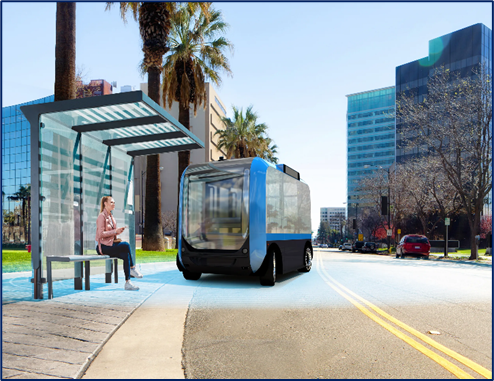
Figure 2: Average costs to deploy an automated shuttle, such as the concept depicted above, were compiled by an international study (Source: ITS JPO). - Cleveland, Ohio – Pedestrian Crossing Warning System. The deployment of a pedestrian crossing warning system in Cleveland, Ohio (2022-SC00516) included V2X technologies and FLIR cameras at pedestrian crossings for enhanced pedestrian detection. Installed systems included both in-vehicle subsystems (IVS) on the transit vehicles, and a roadside subsystem (RS) at each upgraded intersection. The overall deployment was estimated to cost $359,000 (2022 USD). The cost to upgrade individual buses with the IVS ranged from $25,000 to $51,000, and the cost to upgrade intersections with the RS ranged from $53,000 to $83,000. The team additionally estimated the cost of full-scale system deployment at $2,200,000. An evaluation of the installed system found that driver reaction time was reduced by nearly 20%, falling from 1.6 seconds to 1.3 seconds.
- Canberra, Australia – Modeled Demand-Response Transportation System. An Integrated-Demand Responsive Transportation (I-DRT) deployment connecting travelers to traditional public transportation systems in Canberra, Australia (2025-SC00568), was modeled using real-world fare card data. Different deployment strategies were analyzed, accounting for different operational goals. A strategy optimizing for cost-efficiency was estimated to be able to run at $2,500 (2025 USD) per day, using 11-12 12-seater vans. Optimizing for travel time was estimated to cost $6,600 per day, using up to 32 vehicles; this was approximately the same as the cost of traditional public transit ($6,500 per day).
- Worldwide – Automated Shuttle Analysis. A study (2024-SC00553) summarizing best practices for deploying fully automated shuttles, drawing from 120 deployments across the world and from the results of two surveys to deployers and users, provided operational cost estimates in addition to lessons learned (below). The capital cost of a fully automated shuttle with a passenger capacity of 12–15 was estimated to be between $225,000 and $250,000. Annual operation costs ranged from $15,000 to $100,000.
Best Practices
The Greater Cleveland RTA, as described in Table 1, above, used funding granted through the ATCMTD Program to replace and upgrade their CAD/AVL system (2024-L01222). The previous system had been installed in 2001, and many components could no longer be maintained or replaced, leading to significant safety issues and gaps in service. Systems were upgraded and replaced over a 14-month period from July 2019 to September 2020. In a post-deployment assessment, the team emphasized the importance of dedicating internal team members to technological deployments. Managing projects internally allowed the team to better understand the system and ensure timely, high-quality support and maintenance.
The Pima County Regional Transportation Authority (RTA)’s Adaptive Mobility with Reliability and Efficiency (AMORE) project, funded as a Mobility on Demand (MOD) Sandbox demonstration, launched a subscription-based transit service named RubyRide (2024-L01208). In post-deployment evaluations, the team offered key lessons learned from deploying their new service. Recommendations include:
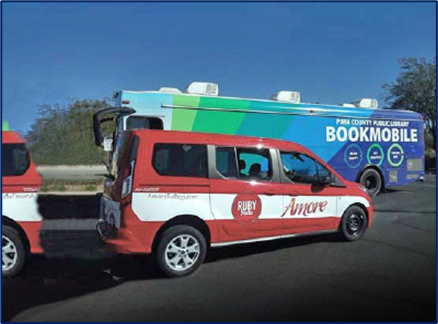
- Choose service areas to meet transportation needs, not for geographic convenience. While offering one-to-one replacement with previously existing fixed-route services may seem logical, if the service already suffers from low ridership, it is important to examine whether it gets travelers to where they want to go.
- Consider both technological and legal challenges when planning for a deployment. The project ran into issues related to both technology, such as issues working on some mobile platforms, and in procuring insurance coverage. While technological issues may be the most obvious in advance, make sure to evaluate institutional needs and concerns.
- Emphasize education and outreach efforts through multiple stakeholders. The project faced challenges in digital marketing due in part to the small population size and to preconceived notions about TNCs.
A 2023 study on Autonomous Shuttle Implementation and Best Practices assembled lessons learned and best practices for those pursuing their own AV deployments (2023-L01194). These included:
- Improve signage and infrastructure before investing in AVs. The study noted that basic improvements to transit parking facilities and road signage smoothed the way for automated vehicles by ensuring they would be deployed in well-maintained, clearly marked areas.
- Make data safety a vital part of the deployment. Cybersecurity considerations should be built in from the ground up to ensure that the high quantities of data necessary to train and operate an AV remain secure and improve user trust in the system.
- Allow an extended (6-12 month) pilot period. This enables monitoring and responding to unforeseen challenges and operational issues. By building in an extensive trial period, the impact of testing challenges can be mitigated.
Success Story
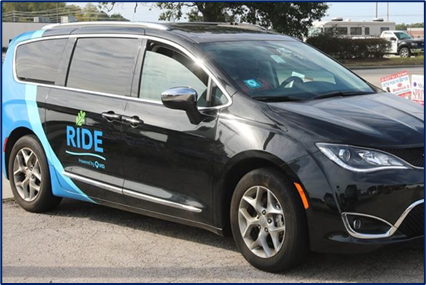
The City of Wilson, NC, replaced its existing fixed-route transit system with an on-demand microtransit service called RIDE (2025-B01910). Wilson faces challenges with providing FMLM service due to its low population density and budget constraints for fixed-route service. The City of Wilson contracted with a private company to set up their microtransit service. Later, with assistance from an FTA AIM grant, they were able to expand their existing service by funding an additional 2.5 hours in operational time per weekday. Travelers may request a trip on RIDE for a flat fare and be transported from a nearby pickup location to their destination. The new service covered a broader geographic area than its previous fixed transit route.
Benefits
Benefits identified in the post-deployment evaluation included:
Over the course of the demonstration, ridership experienced a 58 percent increase, from 9,000 rides in March 2021 to 14,200 in February 2022.
- By the end of the demonstration period, RIDE was capable of meeting 99 percent of demand.
- Nearly three-quarters of survey respondents noted that the RIDE service saved them money, and forty percent that it reduced their commute time. Survey respondents also noted that the expanded hours were specifically useful in helping them get to or from work, which would have fallen outside of the previous operational window.
Challenges and Lessons Learned
The deployment faced some challenges in both vehicle and driver availability:
- Over the course of the demonstration, the project experienced vehicle maintenance issues, to the point that more than half the vehicles in the fleet could be out of order at a time. This was resolved by switching vendors.
- To address issues of driver availability, the service offered pay raises to drivers taking low-volume shifts and launched a new driver acquisition campaign to increase the pool of available drivers at any time. These were both successful in securing greater driver availability.
Recommendations from the Independent Evaluation (IE) of the project include:
- Partnerships are vital. The partnership between the North Carolina Department of Transportation (NCDOT) and the City of Wilson was instrumental to the success of the project. NCDOT led the effort to obtain the AIM grant and helped coordinate project oversight required by FTA. NCDOT was also helpful in connecting Wilson with other communities across the state to share information about the project’s implementation.
- Be responsive to changing costs and service needs. RIDE launched during the COVID-19 pandemic and faced both a difficult labor market and later inflation and rising gasoline costs. Project leaders suggested considering price-in rising costs to fares to avoid needing to raise them soon after a service is launched.
- Establish reporting protocols for accidents and complaints. Protocols should be communicated to drivers, operators, and customers as appropriate, and specify how and when the service provider reports information to the transit agency. This helps to ensure that all incidents are appropriately responded to and documented.